
Our Editorial Standards & Review Process
PEMF Sage exists to provide conservative, evidence-aligned information about pulsed electromagnetic field (PEMF) therapy. This page explains how content is researched, written, reviewed, and updated so readers can understand how and why information is presented the way it is.
Our editorial process prioritizes clarity, physiological accuracy, and trust. We do not position PEMF therapy as medical treatment, nor do we make diagnostic or disease-specific claims. Instead, we focus on educational context, typical usage patterns, and what current research suggests—within clearly defined limits.
This approach reflects the nature of PEMF as a wellness-adjacent modality that is still actively studied. Rather than framing content around promises or outcomes, we emphasize understanding: how PEMF devices are commonly used, what biological systems are discussed in the literature, and where scientific consensus clearly ends.
Readers should expect consistent framing across the site. Definitions, terminology, and explanatory models are reused intentionally so that concepts build logically over time, supporting comprehension rather than novelty.
This editorial framework also exists to set expectations for scope. PEMF Sage does not attempt to resolve debates within the research community or forecast future clinical conclusions. Where questions remain open, that uncertainty is preserved rather than minimized.
By maintaining consistent definitions and explanatory boundaries across all pages, the site is designed to function as a long-term reference rather than a collection of isolated articles. This consistency supports reader understanding as topics become more detailed across the informational and commercial sections of the site.
Evidence Selection & Source Requirements
All PEMF Sage content is grounded in reputable institutional and peer-reviewed sources. We reference research and guidance from organizations such as the National Institutes of Health, PubMed-indexed journals, the Cleveland Clinic, and the Mayo Clinic.
When evidence is limited, mixed, or emerging, this uncertainty is stated directly. We avoid extrapolating findings beyond their original scope and do not imply outcomes that research has not reasonably supported.
Evidence is evaluated not only for results, but for methodology. Study population, signal parameters, exposure duration, and study design are all considered when determining how broadly findings can be discussed. Animal studies, in vitro research, and small human trials are clearly distinguished from larger clinical observations.
Preference is given to sources that describe underlying biological mechanisms rather than outcome-focused summaries alone. This includes research discussing electromagnetic signaling, ion exchange behavior, and circulation-related observations at a conceptual level.
When citing institutional guidance, PEMF Sage avoids extracting statements out of context or presenting general electromagnetic research as PEMF-specific unless the distinction is clearly supported. This helps prevent overstating relevance and maintains alignment with evidence quality.
Where review articles or consensus statements are available, these are prioritized over isolated findings. This helps ensure that content reflects the broader scientific context rather than selectively highlighting favorable results.
For readers seeking an overview of commonly discussed effects and limitations, see our PEMF Therapy Benefits (Science-Backed Overview) page.
PEMF Sage does not accept sponsorship fees for favorable coverage, paid placements disguised as editorial content, or compensation tied to specific claims or conclusions. Affiliate revenue is generated only when a reader independently chooses to engage with a qualifying partner after reviewing the educational material.
This structure helps separate educational intent from transactional outcomes. Content is written first to explain concepts, limitations, and decision frameworks, with monetization applied only where appropriate and compliant with disclosed standards.

Language, Claims & Tone Guidelines
PEMF Sage uses deliberately conservative language. Terms such as support, may influence, or is studied in relation to are used instead of definitive outcome statements.
We do not publish content that claims PEMF therapy can treat, cure, or diagnose medical conditions. Symptom-specific or disease-focused framing is avoided unless discussing research boundaries, safety considerations, or misconceptions.
This restraint is intentional. Overly confident language can misrepresent both the current state of evidence and the variability of individual responses observed in real-world use. Our tone reflects uncertainty where it exists and avoids implying predictability where none has been established.
Similarly, anecdotal testimonials, personal success stories, or before-and-after narratives are excluded from editorial content. While such accounts may be meaningful on an individual level, they are not a reliable basis for generalized education.
Language choices are reviewed during editing to ensure that speculative phrasing is not unintentionally presented as established understanding. Even subtle wording changes can materially affect how readers interpret certainty, so clarity takes precedence over stylistic variation.
Comparative language is also limited. PEMF Sage avoids framing devices as “better,” “stronger,” or “more effective” unless discussing clearly defined technical characteristics rather than outcomes.
This approach reflects our commitment to reader trust and long-term credibility rather than short-term promotional impact.

Product Reviews & Monetization Safeguards
PEMF Sage is an affiliate-supported website, but monetization never overrides editorial standards. Only brands with verified affiliate relationships are eligible for pricing references, calls to action, or product offer schema.
Editorial-only brands may still be discussed for educational comparison, but without promotional language, pricing, or purchase links. This separation helps ensure that reviews remain balanced and informative.
Product coverage focuses on design characteristics, configuration options, and typical use contexts rather than promises of effect. Specifications such as mat size, controller flexibility, and system category are discussed descriptively, not evaluatively.
Selection criteria for inclusion in reviews are based on availability, transparency of manufacturer information, and relevance to common home-use categories. Products are not included solely due to brand recognition or marketing prominence.
Where data gaps exist—such as incomplete technical disclosures or limited published research—those limitations are stated directly. Absence of information is not interpreted as negative or positive, but simply as unknown.
Affiliate relationships are disclosed clearly and consistently. They do not influence which physiological mechanisms are discussed or how research limitations are framed.
Full details about how affiliate relationships work are outlined on our Affiliate Disclosure & Monetization Policy page.

Image & Media Use Standards
All images used on PEMF Sage come from a locked, site-specific image library. Editorial illustrations are designed to support understanding without implying medical outcomes. Product images, when used, are real manufacturer-supplied photos and appear only on appropriate commercial pages.
Images are never used to suggest treatment effects, diagnoses, or guaranteed results. Their role is explanatory and contextual, not persuasive.
Lifestyle imagery is intentionally neutral, showing everyday environments rather than clinical or therapeutic settings. This helps reinforce the educational nature of the content and avoids visual cues that could be misinterpreted as medical endorsement.
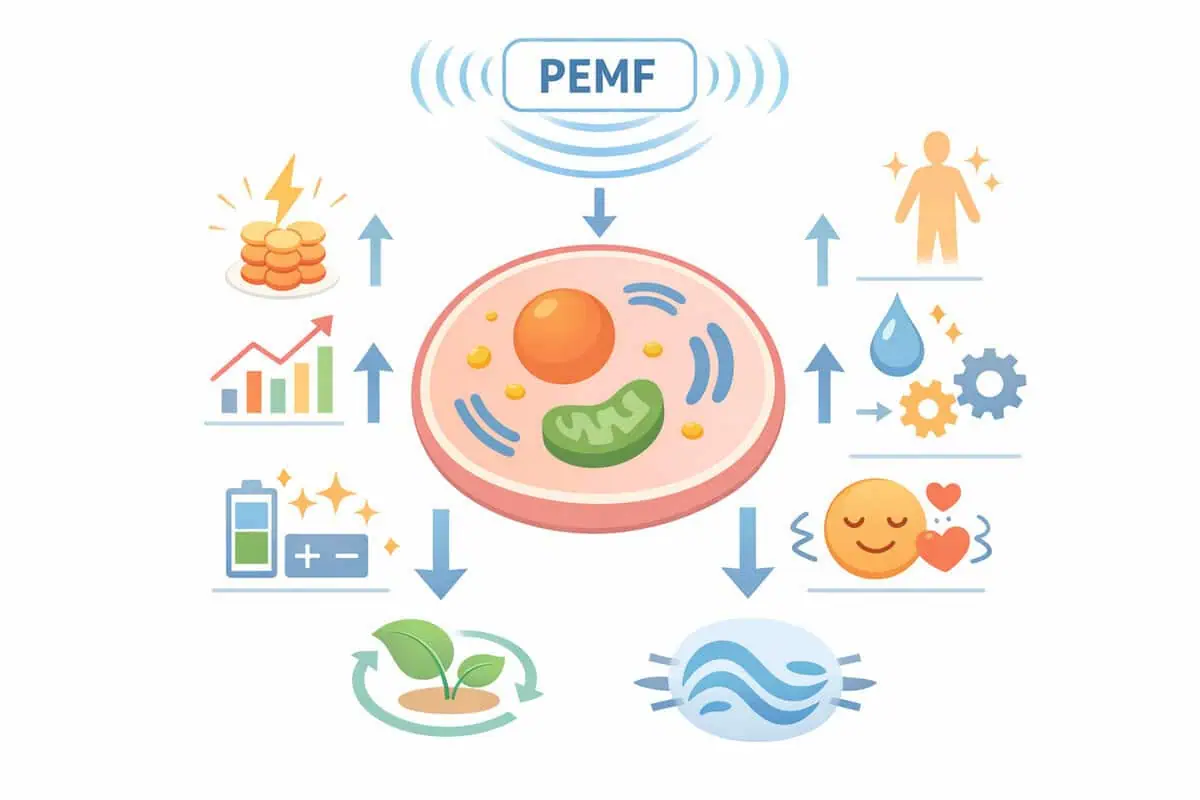
Diagrams and illustrations are simplified representations intended to clarify concepts such as cellular signaling or circulation pathways. They do not depict biological processes at clinical or diagnostic resolution.
Image reuse is controlled to maintain visual consistency while avoiding overrepresentation of any single scenario. No image is intended to imply frequency, outcome, or endorsement of a specific routine or device configuration.
Alt text is written descriptively to support accessibility and clarity, not to introduce claims or conclusions that are not present in the surrounding content.
Ongoing Updates & Reader Accountability
PEMF research and consumer devices continue to evolve. Content on PEMF Sage is periodically reviewed and updated to reflect new evidence, clarified guidelines, or improved explanations.
Updates may include revised language, additional context, or clearer distinctions between established findings and exploratory research. Older content is not removed solely due to age but is reassessed for ongoing relevance and accuracy.
Editorial updates follow the same standards as initial publication. New information is incorporated conservatively, and previously accurate content is not reframed solely for novelty or search trends.
This process reflects PEMF Sage’s emphasis on durability over immediacy, ensuring that readers can return to foundational pages with confidence that changes are made deliberately and transparently.
If errors, ambiguities, or outdated references are identified, corrections are made promptly. Readers with questions or concerns about our editorial approach are encouraged to reach out via the Contact PEMF Sage page.
For current articles and educational resources, visit the PEMF Sage Blog.