How PEMF Therapy Works at the Cellular Level
Published: October 18, 2025
Last updated: January 10, 2026

Pulsed electromagnetic field (PEMF) therapy is often described at a high level, but its proposed effects are rooted in fundamental cellular processes. This informational guide explains how PEMF therapy is thought to interact with cells, tissues, and biological signaling systems—without framing PEMF as a treatment or cure.
Rather than focusing on outcomes, this page explores PEMF cellular mechanisms: how low-intensity electromagnetic signals may influence ion exchange, microcirculation, and cellular communication under controlled conditions. For broader context on applications and devices, readers can explore the Best PEMF Devices & Mats (2026 Buyer’s Guide).
A helpful way to read this page is to keep the scope narrow: the emphasis is on how biological systems work (electrical gradients, signaling pathways, and tissue-level delivery), and how PEMF is studied as a low-level external signal within those systems. If you want a broader “what is PEMF” orientation before diving into mechanisms, you can also start at the PEMF Sage Blog for the full educational sequence.
What “Cellular-Level Interaction” Means in PEMF Therapy
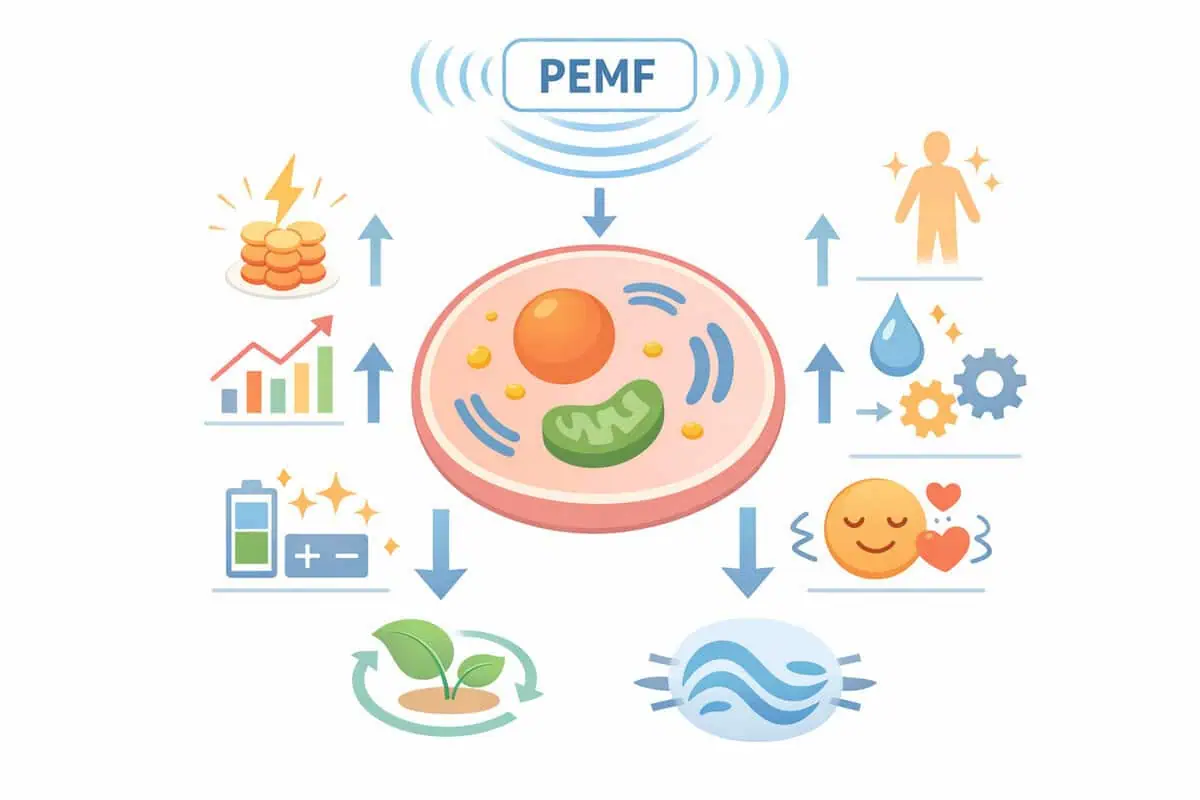
When PEMF therapy is discussed at the cellular level, it does not imply direct structural changes to cells. Instead, research explores how weak electromagnetic fields may interact with existing biological signaling processes that cells already use to communicate and adapt.
Cells rely on electrical gradients, ion movement, and signaling cascades to regulate everyday functions. PEMF signals are theorized to act as external inputs that may subtly influence these processes, particularly where electrical activity is already present.
In practice, “cellular-level” often means the discussion stays close to first principles: membranes that hold electrical charge, proteins that open and close to move ions, and messenger molecules that translate signals into short-lived responses. This is different from the way supplement marketing sometimes uses “cellular” as a vague synonym for “powerful.” Here, it is a technical framing that helps keep expectations conservative.
Ion Channels and Electrical Gradients

Ion channels are protein structures embedded in cell membranes that regulate the movement of charged particles such as calcium, sodium, and potassium. These ions are essential for maintaining electrical balance and cellular responsiveness.
Some PEMF research examines whether pulsed electromagnetic fields may influence ion channel behavior indirectly, potentially affecting how easily ions move across membranes. This line of investigation aligns with broader bioelectromagnetic research summarized in resources such as the NIH National Library of Medicine.
A useful starting concept is the membrane potential. Cells maintain a difference in electrical charge across the membrane by controlling ion concentration inside versus outside the cell. This electrical separation is not “extra”—it is a core part of how cells coordinate transport, maintain stability, and respond to signals.
Ion channels are one of the main control points for this system. They open or close in response to specific triggers (voltage changes, chemical binding, mechanical forces), and even small changes in channel activity can shift how a cell behaves in the moment. In PEMF research, the key question is not whether PEMF “forces” channels open, but whether the external signal might bias certain electrically sensitive behaviors under certain conditions.
It is also important to note what “indirect influence” can mean in physiology:
- Changes in local field dynamics near membranes in controlled settings.
- Small shifts in ion exchange timing rather than large shifts in total ion movement.
- Downstream effects that depend on baseline state (hydration, tissue oxygenation, stress load, activity level).
Because these processes are tightly regulated, credible summaries avoid presenting ion channels as a simple on/off switch that PEMF can reliably “flip.” A more conservative view is that PEMF is explored as a mild external input that could interact with existing regulatory systems—sometimes measurably in experiments, but not predictably for every person in every context.
Calcium Signaling as a Central Focus

Calcium ions play a central role in cellular signaling, acting as messengers for muscle contraction, nerve transmission, and metabolic regulation. Because calcium movement is electrically sensitive, it is frequently discussed in PEMF literature.
Published studies indexed on PubMed explore how electromagnetic exposure may influence calcium-dependent pathways under laboratory conditions, though these findings remain context-specific and non-clinical.
Calcium signaling is often described as “central” because calcium acts like a rapid messenger inside cells. When calcium concentration changes in a controlled way, it can trigger short-term actions (like contraction or secretion) or influence longer signaling cascades that affect how cells respond to stress and recovery demands.
In PEMF discussions, calcium is relevant for two conservative reasons:
- Electrical sensitivity: calcium movement is part of electrically regulated systems in membranes and intracellular compartments.
- Downstream signaling: calcium-dependent pathways intersect with other regulatory systems (including nitric oxide signaling, vascular tone regulation, and cellular metabolism).
However, calcium signaling is also one of the easiest areas for marketing to overreach. A laboratory observation that a field exposure changes calcium dynamics does not establish that a consumer device will deliver the same effect in a daily routine, or that any observed change is beneficial in a generalized sense.
A conservative interpretation treats calcium discussions as a mechanism candidate that helps explain why researchers look at PEMF in the first place. If you want the broader, user-facing view of what PEMF is commonly discussed to support—without drifting into promises—the PEMF Therapy Benefits (Science-Backed Overview) page is designed to keep that boundary clear.
PEMF and Microcirculation Pathways

Microcirculation refers to blood flow through the smallest vessels, including capillaries. Healthy microcirculation supports oxygen and nutrient delivery at the tissue level.
Some hypotheses suggest PEMF signals may influence vascular signaling or endothelial function indirectly. Institutions like the Cleveland Clinic emphasize that circulation is regulated by complex biological systems, and any external influence must be interpreted conservatively.
From a physiology standpoint, microcirculation is less about “bigger blood flow” and more about distribution—how effectively oxygen and nutrients reach tissues that need them. Many factors influence this distribution, including hydration, temperature, movement, autonomic balance, and endothelial signaling (the layer of cells lining blood vessels).
When PEMF is discussed in relation to microcirculation, the most conservative framing is that researchers explore whether electromagnetic signals can interact with vascular signaling pathways that regulate tone and responsiveness. This is not a claim that PEMF “improves circulation” for everyone; it is an explanation of why circulation is commonly used as a plausible pathway in research discussions.
It also helps to keep microcirculation distinct from large-vessel cardiovascular function. Microcirculation is primarily about capillary-level exchange and local regulation. For readers who want a broader safety and risk framing—especially if they have cardiovascular conditions or implanted devices—PEMF Sage maintains a dedicated safety reference at PEMF Therapy Safety, Risks & Contraindications.
Mitochondria and Cellular Energy Processes
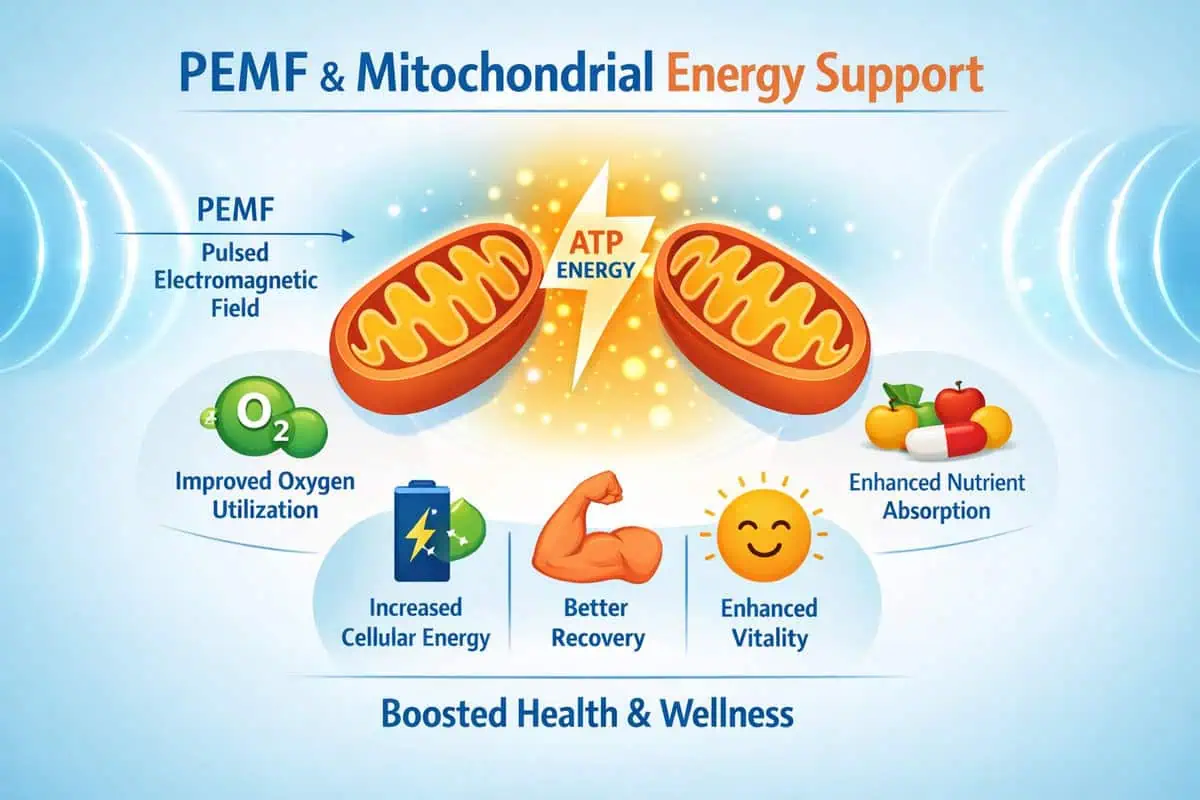
Mitochondria generate ATP, the primary energy currency of cells. Because mitochondrial activity involves electrical and chemical gradients, it is sometimes referenced in PEMF discussions.
Educational reviews note that PEMF is studied as a potential modulator of cellular energy environments, not as an energy source itself. The Mayo Clinic cautions that energy metabolism is influenced by many variables, including nutrition, oxygen availability, and overall health.
Mitochondria are relevant here because they depend on gradients—differences in charge and concentration—to produce ATP efficiently. These gradients are carefully regulated, which is why credible discussions avoid implying that PEMF “charges” mitochondria or “forces” ATP production.
A conservative, mechanism-focused way to describe the research interest is this: if PEMF influences signaling pathways that affect oxygen delivery, ion handling, or cellular stress responses, it could indirectly intersect with metabolic efficiency in some settings. That is a chain of plausibility, not a guaranteed endpoint.
For readers evaluating claims about “energy,” it can be helpful to separate:
- Cellular energy production (ATP, metabolic regulation).
- Subjective energy (sleep quality, stress load, routine consistency).
- Performance readiness (training load, recovery, hydration, nutrition).
These layers often move together in real life, but they are not interchangeable. Keeping them separate helps maintain a YMYL-appropriate, evidence-aligned tone.
Cellular Adaptation and Homeostasis
Cells constantly adapt to environmental inputs to maintain homeostasis. Mechanical forces, chemical signals, and electrical cues all contribute to this adaptive process.
PEMF therapy is explored within this framework—as a low-level signal that may interact with adaptive pathways rather than override them. This distinction is important for understanding why PEMF is positioned as a wellness-support modality rather than a medical intervention.
Homeostasis is often described as “balance,” but in physiology it is closer to dynamic regulation. The body is always adjusting to internal and external conditions—sleep, stress, activity, temperature, and nutrition all alter signaling priorities.
Within that context, PEMF is typically framed as a routine-based input. That framing has two practical implications:
- Consistency matters more than intensity: small signals used consistently are often discussed more than aggressive exposure.
- Baseline state matters: two people can have different responses because their systems are adapting to different loads.
This is also why reputable PEMF education usually emphasizes the “support” language: the goal is not to claim that PEMF overrides physiology, but that it may fit alongside other steady routines (movement, sleep hygiene, recovery practices) that already influence the same adaptive pathways.
Nervous System Signaling Considerations

The nervous system relies heavily on electrical signaling, making it a frequent topic in PEMF research discussions. Studies often focus on peripheral signaling rather than central nervous system effects.
For a broader overview of nervous system topics related to PEMF, readers may explore the PEMF Therapy Benefits (Science-Backed Overview), which contextualizes these mechanisms within conservative educational boundaries.
A conservative approach also acknowledges boundaries: PEMF education should not imply that electromagnetic exposure “treats” mental health conditions or “rewires” the brain. Instead, nervous system discussion is typically framed around general regulation themes such as relaxation response, comfort during sessions, and routine compliance.
From a practical standpoint, many users report that sessions feel subtle—mild pulsing sensations, warmth from the mat materials (not necessarily from the field itself), or a quiet “rest” window. Those experiences are not proof of a specific biological mechanism, but they can help explain why PEMF is often used during calm routines rather than high-stimulation activities.
Frequency, Intensity, and Signal Design

Cellular responses to electromagnetic exposure are highly dependent on signal characteristics such as frequency, waveform, and intensity. This is why PEMF devices vary widely in design.
Educational resources emphasize that “more” is not necessarily better; subtle, low-intensity signals are often the focus of research. This principle is explored further in related educational posts within the PEMF Sage Blog.
Why Effects Are Subtle and Individual

Because PEMF signals interact with existing biological systems, responses can vary widely between individuals. Factors such as baseline health, lifestyle, and consistency of use all influence observed experiences.
This variability underscores why PEMF discussions remain conservative and why claims of guaranteed outcomes are avoided in credible educational resources.
Variability can show up in simple ways: some people notice a relaxed “downshift” during sessions, while others report little subjective change. Neither experience is unusual, and neither confirms or disproves cellular-level mechanisms.
A conservative way to think about “subtle effects” is that PEMF is not typically described as a dramatic, immediate intervention. When people do report changes, they often describe them as gradual and routine-linked—more similar to how consistent sleep habits or recovery practices feel over time than how a stimulant feels in the moment.
If you want to sanity-check whether PEMF is a reasonable fit for your situation, or whether it conflicts with medications, devices, or medical guidance, PEMF Sage provides a dedicated reference at PEMF Therapy Safety, Risks & Contraindications.
Common Misinterpretations of Cellular Research

Laboratory findings are sometimes overstated when translated into consumer language. Cellular-level observations do not automatically imply clinical benefits.
PEMF Sage adheres to editorial standards outlined on the Editorial Standards & Review Process page to ensure research context is preserved accurately.
Three common misinterpretations show up repeatedly in PEMF content online:
- Equating plausibility with proof: a plausible mechanism is not the same as a reliable outcome.
- Overgeneralizing from narrow populations: a finding in a specific setting may not apply broadly.
- Assuming “more intensity” is superior: stronger signals are not automatically more appropriate, especially for routine use.
A conservative reader also looks for “missing context” signals, such as vague claims without clear source quality, or statements that imply disease-specific outcomes. Those are red flags for YMYL-aligned editorial standards, and they are also the reason PEMF Sage keeps language restrained even when discussing mechanisms.
Connecting Mechanisms to Practical Understanding

Understanding cellular mechanisms helps set realistic expectations for PEMF therapy. Rather than dramatic changes, PEMF is discussed as a supportive input within a broader wellness routine.
Those evaluating devices should consider how signal design aligns with these mechanisms, a topic explored in detail within the Buyer’s Guide and related informational posts.
At a practical level, “mechanisms” help you ask better questions when reading device marketing. Instead of chasing broad claims, you can focus on a few grounded considerations:
- Does the device clearly describe signal parameters? (frequency ranges, intensity approach, and intended use).
- Is the recommended routine realistic? (session length, comfort, ease of setup).
- Is safety guidance visible and conservative? (clear contraindications and “when to ask your clinician” prompts).
For readers who want help interpreting devices without turning education into promotion, the best next step is to review the device landscape in the Best PEMF Devices & Mats (2026 Buyer’s Guide), then use the Contact PEMF Sage page if you have a specific question about how to evaluate claims against conservative standards.
Conclusion: A Conservative View of PEMF Cellular Mechanisms
PEMF therapy is studied through the lens of cellular signaling, ion exchange, and adaptive biological processes. While research continues to explore these interactions, current understanding emphasizes subtlety, variability, and context.
For readers interested in how these mechanisms translate into real-world device design, the next step is reviewing the Best PEMF Devices & Mats (2026 Buyer’s Guide), which applies these principles in a practical, comparison-focused format.