PEMF Therapy for Healthy Aging & Longevity

PEMF therapy for healthy aging is increasingly discussed in the context of cellular resilience, circulation support, and nervous system balance. As interest in longevity grows, many people are exploring non-invasive wellness tools that may support the body’s natural regulatory processes over time.
Rather than focusing on disease treatment or anti-aging claims, this guide explains how pulsed electromagnetic field therapy is theorized to interact with cellular signaling, mitochondrial function, and microcirculation — all of which play a role in how the body adapts and recovers as it ages.
In practical terms, “longevity” conversations often blend two ideas: (1) maintaining day-to-day function (energy, mobility, sleep quality, stress tolerance) and (2) preserving the physiological capacity to recover from normal stressors like exercise, travel, or disrupted sleep. PEMF therapy is usually positioned as a gentle, routine-friendly modality that may complement those goals when used consistently and conservatively.
Throughout this article, “support” means potential alignment with normal physiology (comfort, relaxation, circulation, recovery patterns), not treatment of a condition. If you are evaluating devices for home routines, it can help to approach PEMF the same way you would approach other wellness inputs: start low, track your response, and keep expectations realistic.
What Healthy Aging Really Means

Healthy aging does not mean stopping time. It refers to maintaining functional capacity — mobility, cognitive clarity, circulation, sleep quality, and stress adaptability — as the years progress.
Healthy aging is also highly individualized. Two people of the same age can have very different baselines in terms of strength, flexibility, cardiovascular conditioning, sleep stability, and stress load. Because PEMF is typically used as a supportive input rather than a primary intervention, the most useful framing is: “Does this fit my routine, and does it feel like it supports my recovery and regulation?”
A helpful way to think about function over time is to focus on “systems” rather than “symptoms.” For many adults, the day-to-day experience of aging is shaped by a few practical variables:
- Recovery bandwidth: how quickly you return to baseline after normal exertion
- Sleep stability: how reliably you get restorative rest across a typical week
- Mobility continuity: how easy it is to maintain movement habits without extended setbacks
- Stress responsiveness: how quickly your nervous system settles after periods of pressure
- Circulation support: how well tissues feel nourished during activity and rest
According to the National Institute on Aging (NIH), aging involves gradual cellular and physiological changes. These shifts can affect:
- Energy production efficiency
- Inflammatory signaling balance
- Vascular elasticity
- Neurological regulation
- Recovery speed after exertion
PEMF therapy for healthy aging is typically framed as a supportive tool that may help maintain regulatory balance — not as a cure or reversal strategy.
This “regulatory balance” framing matters because it keeps the claims appropriately conservative. Many longevity conversations online jump quickly to strong promises. PEMF Sage takes the opposite approach: explain the plausible physiology, describe typical user experiences without exaggeration, and treat individual response as variable.
Cellular Signaling & Longevity
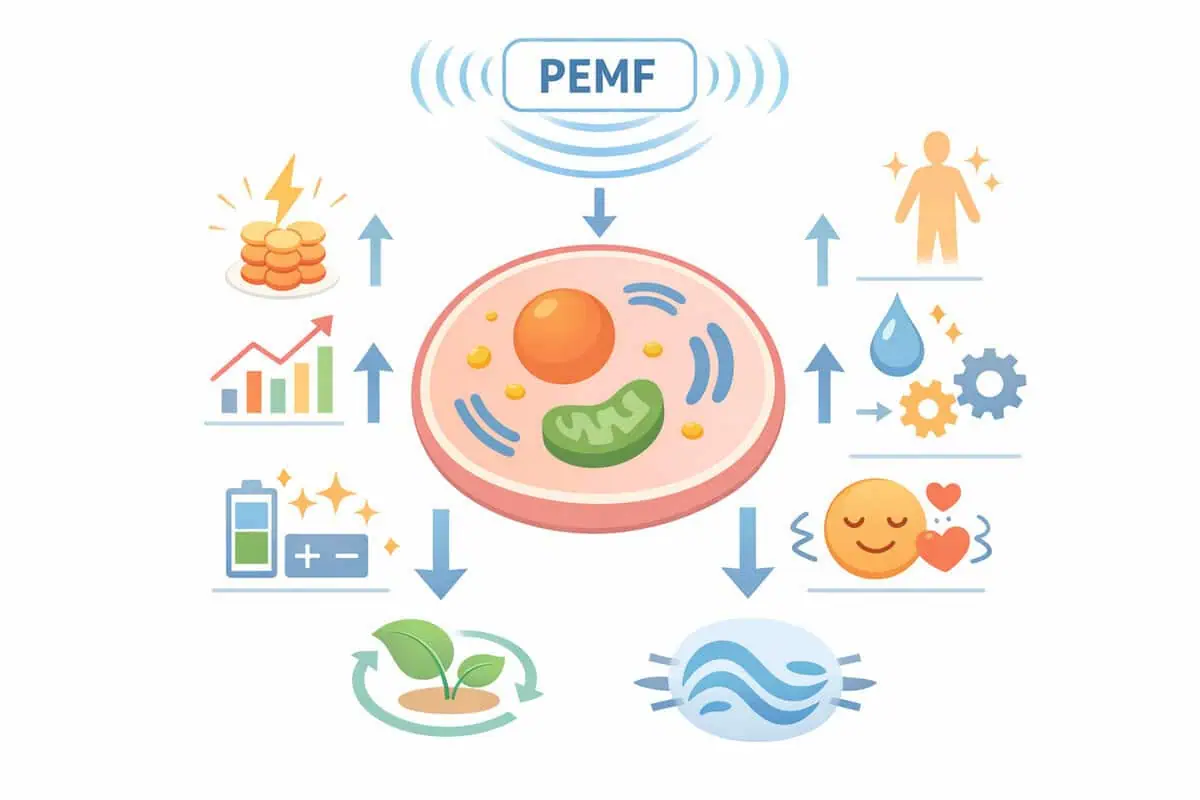
Cells communicate constantly through electrical gradients and ion exchange. Over time, signaling efficiency may decline due to oxidative stress, reduced circulation, and mitochondrial strain.
One reason PEMF is discussed in wellness circles is that biology is not purely “chemical.” Electrochemical gradients help govern how cells move ions, maintain membrane potential, and coordinate signaling. In simple terms, cells must maintain “electrical organization” to do their jobs efficiently. When recovery is slower or stress load is higher, signaling can become less coordinated, which may be reflected in day-to-day experiences like reduced exercise tolerance or longer “bounce-back” time.
PEMF devices generate low-frequency electromagnetic pulses that are theorized to influence ion channel activity and membrane potential stability. Research indexed in PubMed explores how these fields may interact with voltage-gated channels and cellular communication pathways.
A conservative interpretation is that PEMF may act as a mild input that interacts with normal signaling dynamics. That does not mean it overrides biology or forces a specific outcome. Instead, it may be better described as a “context” signal that some users find supportive when paired with foundational habits (sleep, movement, hydration, protein intake, and stress management).
In the context of healthy aging, the interest lies in maintaining efficient signaling — which supports coordinated tissue repair, adaptive stress responses, and balanced inflammatory activity.
When people talk about “longevity,” they often mean preserving the ability to adapt. Adaptation requires coordination: nerves, blood flow, energy production, and immune signaling must communicate effectively. For that reason, PEMF discussions often connect cellular signaling to broader system-level outcomes like recovery patterns, relaxation response, or overall vitality — while acknowledging that the research does not support disease-specific claims.
Mitochondrial Energy & Resilience
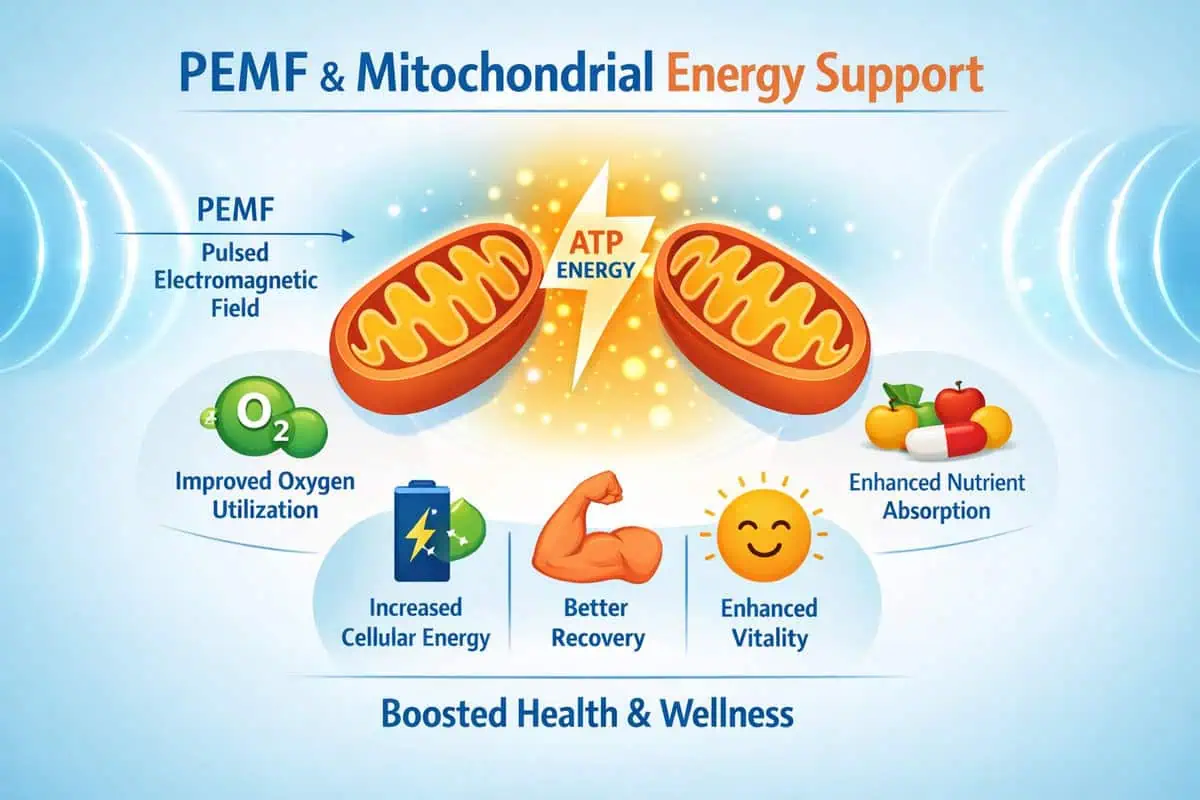
Mitochondria produce ATP, the primary energy molecule used by cells. Age-related mitochondrial inefficiency has been associated with fatigue and slower recovery.
From a wellness perspective, mitochondrial “support” is usually discussed in terms of day-to-day capacity: steady energy, exercise tolerance, and recovery after normal demands. Many factors influence mitochondrial function (sleep debt, nutrient availability, activity levels, stress hormones, and cardiometabolic health), so it is important not to attribute energy changes to a single tool.
Some laboratory research suggests electromagnetic stimulation may influence mitochondrial membrane potential and ATP production dynamics. While human longevity claims are not supported, maintaining mitochondrial function is widely recognized as important for long-term vitality.
A practical way to interpret this: if PEMF feels supportive, the effect may show up indirectly as improved “readiness” to move, train, or maintain routines — not as a dramatic, immediate energy surge. Many users describe PEMF sessions as subtle, where the most noticeable effects relate to relaxation and recovery rather than stimulation.
If you want broader context on energy regulation, see our overview of PEMF therapy benefits.
For device selection, “mitochondrial support” claims are often marketed aggressively. PEMF Sage recommends focusing on measurable device parameters (intensity options, waveform programming, mat size, comfort, and usability) and then evaluating whether consistent use fits your lifestyle over months, not days.
Circulation & Microvascular Support

Healthy circulation ensures oxygen and nutrients reach tissues efficiently. Aging can involve reduced vascular flexibility and slower microcirculatory exchange.
Circulation is not only about the heart and major blood vessels. Microcirculation refers to the smallest vessels where exchange happens at the tissue level. For healthy aging, that exchange capacity matters because it influences how quickly tissues recover after activity and how efficiently they receive oxygen and nutrients.
Studies referenced by the Cleveland Clinic emphasize the importance of vascular health for mobility and organ function.
PEMF therapy for healthy aging is sometimes discussed in relation to microcirculatory support, as electromagnetic pulses may influence vasodilation signaling pathways. This remains an area of ongoing research and should be viewed conservatively.
In day-to-day practice, “circulation support” is often interpreted as how the body feels during and after movement: warmth in tissues, a sense of looseness, or easier recovery after light exercise. These experiences are nonspecific and can be influenced by many factors, so they should be treated as subjective signals rather than proof of a specific physiological change.
Nervous System Regulation Over Time
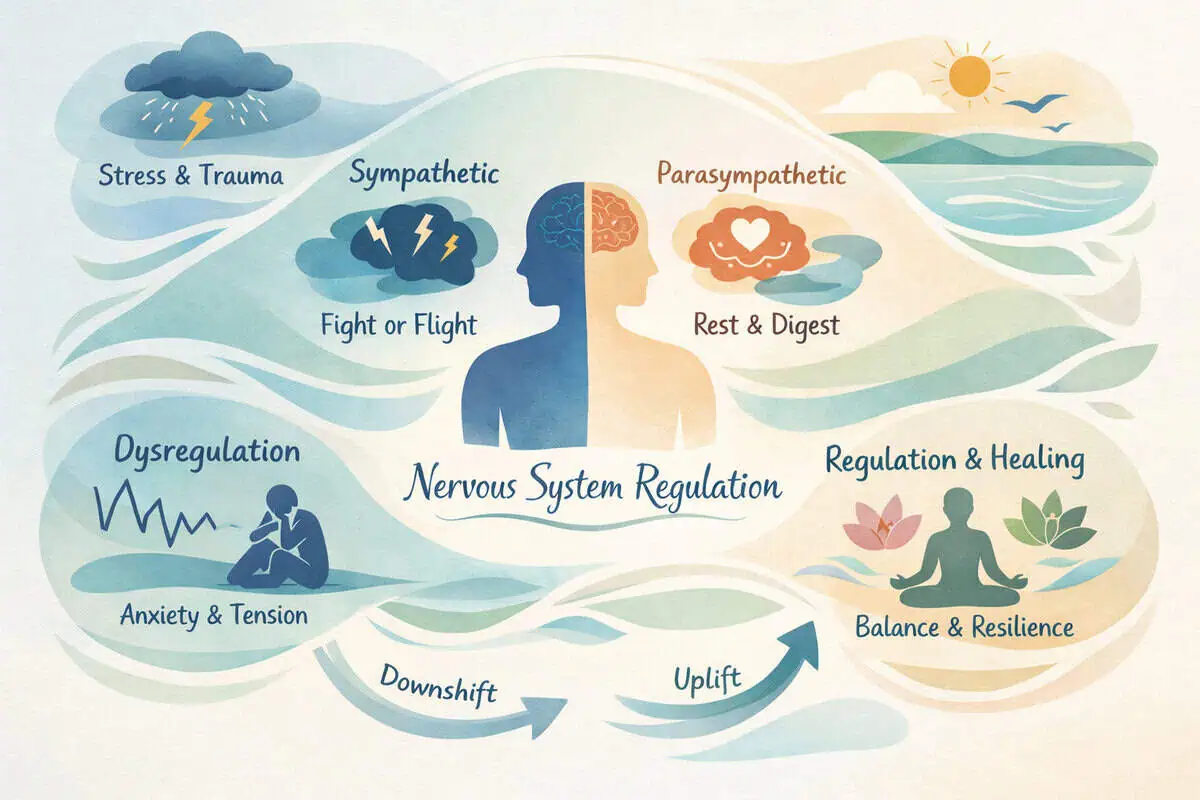
The autonomic nervous system governs stress response, sleep cycles, and recovery states. With aging, stress resilience may shift due to cumulative physiological load.
Many “longevity” routines are essentially nervous-system routines. If the body spends more time in a higher-arousal state (rushing, screens late at night, chronic stress), recovery signals may be weaker. Because PEMF sessions are often performed lying down with controlled breathing, part of the perceived benefit may come from pairing the device with a deliberate downshift in attention and environment.
Some research explores how pulsed electromagnetic exposure may interact with neural signaling pathways and autonomic balance. The Mayo Clinic highlights the importance of stress regulation for long-term health.
Supporters of PEMF therapy describe experiences such as relaxation, subtle pulsing sensations, and post-session calm — though responses vary.
A conservative approach is to treat PEMF as a “window” for regulation rather than a standalone solution. Many people find it helpful to keep sessions consistent (same time of day, similar environment) and to evaluate outcomes that are realistic and non-medical, such as perceived relaxation, sleep readiness, or how quickly they feel settled after a busy day.
Inflammation Signaling & Aging

Chronic low-grade inflammation is often discussed in aging research. Balanced inflammatory signaling is necessary for repair, but dysregulation may contribute to tissue stiffness and recovery delays.
From an educational standpoint, it can help to separate “inflammation” as a normal biological process from inflammation as a persistent imbalance. After exercise or minor strain, inflammatory signaling is part of repair and adaptation. Healthy aging is often about maintaining the body’s ability to return to baseline appropriately after those normal signals.
Emerging studies examine whether PEMF exposure may influence cytokine signaling pathways. These findings are preliminary and do not constitute treatment claims.
In everyday wellness discussions, people often connect this topic to comfort and mobility. PEMF may be perceived as supportive when it helps someone maintain a consistent movement routine without feeling “stuck” after typical activity. That is a functional goal rather than a condition-specific claim.
Sleep Quality & Longevity

Sleep quality plays a major role in cognitive maintenance, hormonal regulation, and immune coordination. Many longevity researchers emphasize restorative sleep as foundational.
For many adults, sleep changes with age: earlier waking, more sensitivity to caffeine, and greater disruption from stress or travel. Because PEMF sessions are often relaxing, some users incorporate them as a “transition ritual” that signals the end of the day.
Some individuals incorporate PEMF sessions in evening routines, reporting feelings of relaxation before bed. You can explore session timing guidance in our guide to best PEMF devices & mats.
Muscle Recovery & Physical Function

Maintaining muscle mass and mobility is central to aging well. Recovery efficiency influences how consistently someone can remain active.
In healthy aging routines, “recovery” often means maintaining continuity. If workouts or walks routinely lead to extended soreness or stiffness, people may reduce activity over time. Tools that support perceived comfort and readiness can indirectly support consistency — which is one of the most reliable predictors of long-term functional capacity.
PEMF therapy for healthy aging is sometimes discussed alongside physical therapy or low-impact exercise routines. Conservative application involves moderate session durations and realistic expectations.
A practical ownership reality is that PEMF is rarely a “one-and-done” solution. If it helps, it typically helps as part of a broader routine that also includes strength training (appropriate for the person), mobility work, adequate protein intake, hydration, and sleep. For that reason, the best device is often the one that is comfortable enough and convenient enough to use consistently.
Typical Usage Patterns for Long-Term Support

Observed usage patterns for longevity-focused routines often include:
- 15–30 minute sessions
- Low to moderate intensity settings
- Consistent weekly frequency
- Full-body mat placement for systemic exposure
These patterns reflect a “dose discipline” mindset. Many users do better with shorter, repeatable sessions than with occasional long sessions. If you are new to PEMF, it can be reasonable to start at the low end of time and intensity, then increase gradually while tracking comfort, sleep readiness, and how you feel after normal activity.
Practical considerations that affect consistency include mat thickness (comfort), control interface simplicity, noise level (if any), and where the device lives in the home. A device that is hard to set up is easier to skip, which reduces the chances of any meaningful long-term routine benefit.
For more detailed session considerations, visit our PEMF Sage blog.
Safety & Contraindications

PEMF therapy is generally considered non-invasive, but it is not appropriate for everyone.
- Implanted electronic devices (e.g., pacemakers)
- Pregnancy
- Active medical conditions requiring physician supervision
In addition, people who are highly sensitive to stimulation may prefer shorter sessions at lower intensity. If someone experiences unusual discomfort, dizziness, or sleep disruption, a conservative response is to reduce intensity/duration or discontinue and seek professional guidance. This is educational information only and is not medical advice.
Review our dedicated Contact PEMF Sage page if you have questions about educational resources. Always consult a qualified healthcare professional before beginning new wellness practices.
If you need to reach us with a site question, you can also use our Contact PEMF Sage form for general education and navigation support.
Setting Realistic Longevity Expectations

Longevity is multifactorial. Nutrition, movement, sleep, social connection, and stress regulation are foundational pillars.
A realistic expectation is that PEMF, if it helps, may support the “inputs” that make healthy aging easier to maintain — like recovery comfort, relaxation, and routine adherence. It is also normal for results to be subtle and gradual, and for some people to notice minimal changes.
PEMF therapy for healthy aging should be viewed as a supportive modality within a broader lifestyle framework — not a standalone intervention.
Final Thoughts on PEMF Therapy for Healthy Aging
PEMF therapy for healthy aging centers on supporting cellular communication, circulation, mitochondrial function, and nervous system balance. While research continues to evolve, current discussions focus on regulatory support rather than anti-aging claims.
If you are exploring device options for home use, begin with our comprehensive Best PEMF Devices & Mats Buyer’s Guide to understand the differences in design, intensity, and intended use.